

Denton-Powell's Carbon Reduction Plan and Sustainability Strategy
Denton-Powell is committed to reducing the environmental impact of our business while supporting clients in achieving their own carbon-reduction objectives. As part of this commitment, Denton-Powell commissioned an energy audit to better understand its carbon footprint and identify controllable factors that impact energy costs and emissions. Balanced Energy was engaged to provide this assessment and guidance.
Who are Balanced Energy
Balanced Energy was founded by energy brokers Ashley and Harry to support businesses facing spiralling energy costs and growing pressures to prove sustainability credentials with a rapidly changing energy sector. Today, Balanced Energy is a Net Zero consultancy helping businesses to move confidently towards a low-carbon future by providing clear strategies and practical solutions that deliver real results.
Balanced Energy and Denton-Powell
Over the past few months, we have been working closely with the team at Balanced Energy. Together we have developed Denton-Powell’s sustainability report and put a plan in place for the years ahead. Balanced Energy have supported our business proposing a sensible strategy focussing on the positive changes that we can consider as a part of our commitment to reducing emissions where we can, while maintaining the quality, safety and reliability our clients expect from us.

Why Denton-Powell are investing into a carbon reduction plan
For us, it is about staying ahead and taking it seriously now, rather than waiting until we are forced to. Expectations are already changing across the construction sector.
In a recent discussion with a prospective client about sustainability requirements within construction procurement, Denton-Powell’s approach to carbon management stood out.

In a recent conversation with a prospective client, we were struck by how uncommon formal carbon reduction plans still are. Out of all the firms they had spoken to, only two companies had one in place, Denton-Powell being one of them. The discussion served as a reminder of the importance of leading by example in the progress towards Net Zero.
Joe Champion, Director, Denton-Powell
Benefits of Carbon Management
Carbon management offers wide-ranging benefits for businesses, making it an increasingly important part of long-term strategy. By measuring and managing carbon emissions, businesses can identify opportunities to reduce environmental impact, improve sustainability, and mitigate climate-related risks. At the same time, effective carbon reduction can help lower energy usage, waste, and transport costs, strengthen social responsibility credentials, and appeal to customers who value environmentally responsible practices.
Understanding Carbon Emission Scopes
In carbon reduction plans, emissions are grouped into three categories known as Scopes:
Scope 1 covers direct emissions from sources an organisation owns or controls, such as fuel used in company vehicles or on-site equipment.
Scope 2 relates to indirect emissions from purchased energy, primarily electricity used to power offices, workshops, and manufacturing processes.
Scope 3 includes all other indirect emissions across the wider value chain, such as the production and transport of materials, waste disposal, employee travel, and subcontractor activity.
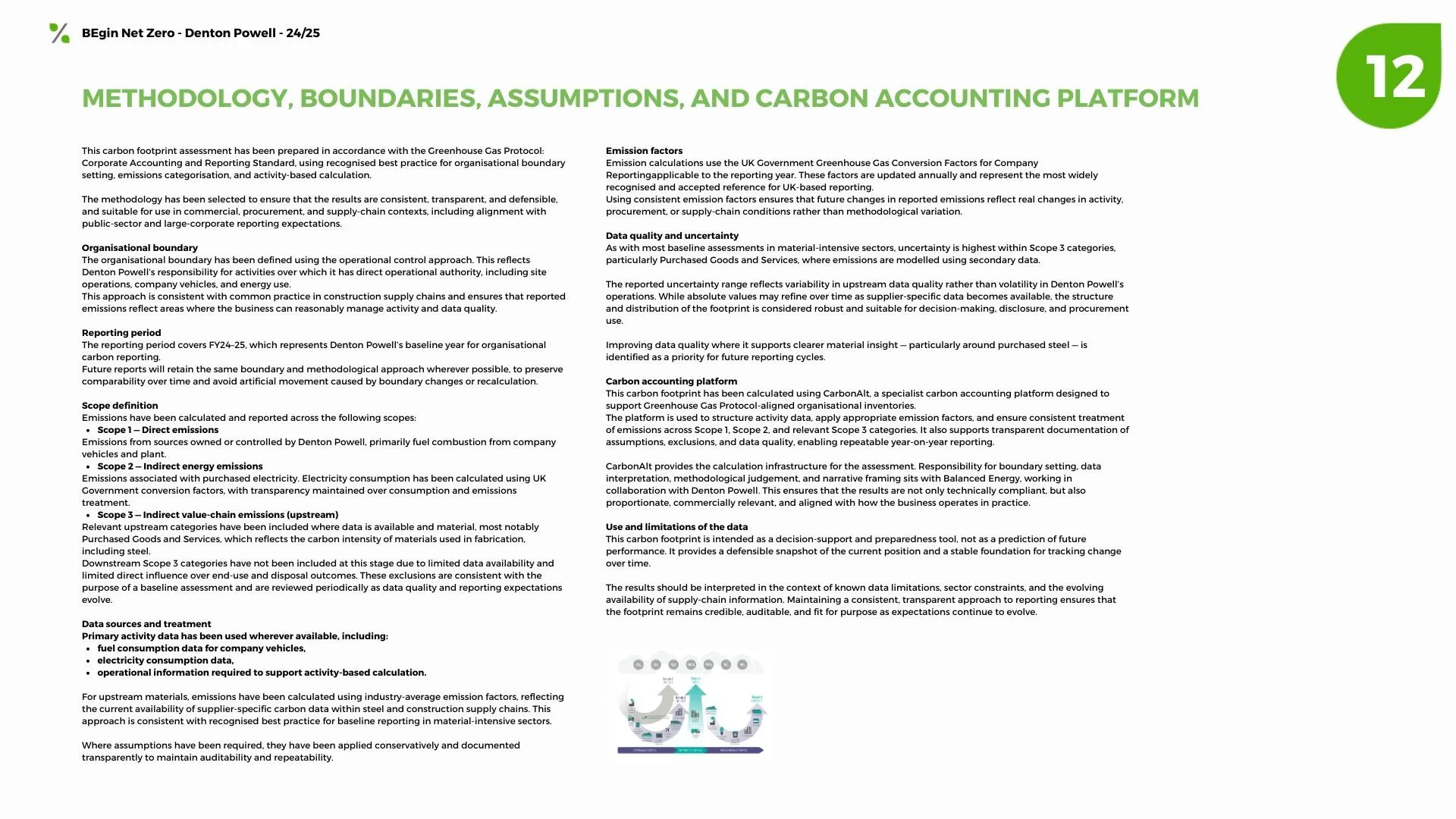
Together, these scopes provide a clear framework for measuring the overall carbon footprint of a business and identifying opportunities to reduce environmental impact.
Denton-Powell's Distribution of emissions by scope
Reporting period: July 24– June 25 (Baseline year)
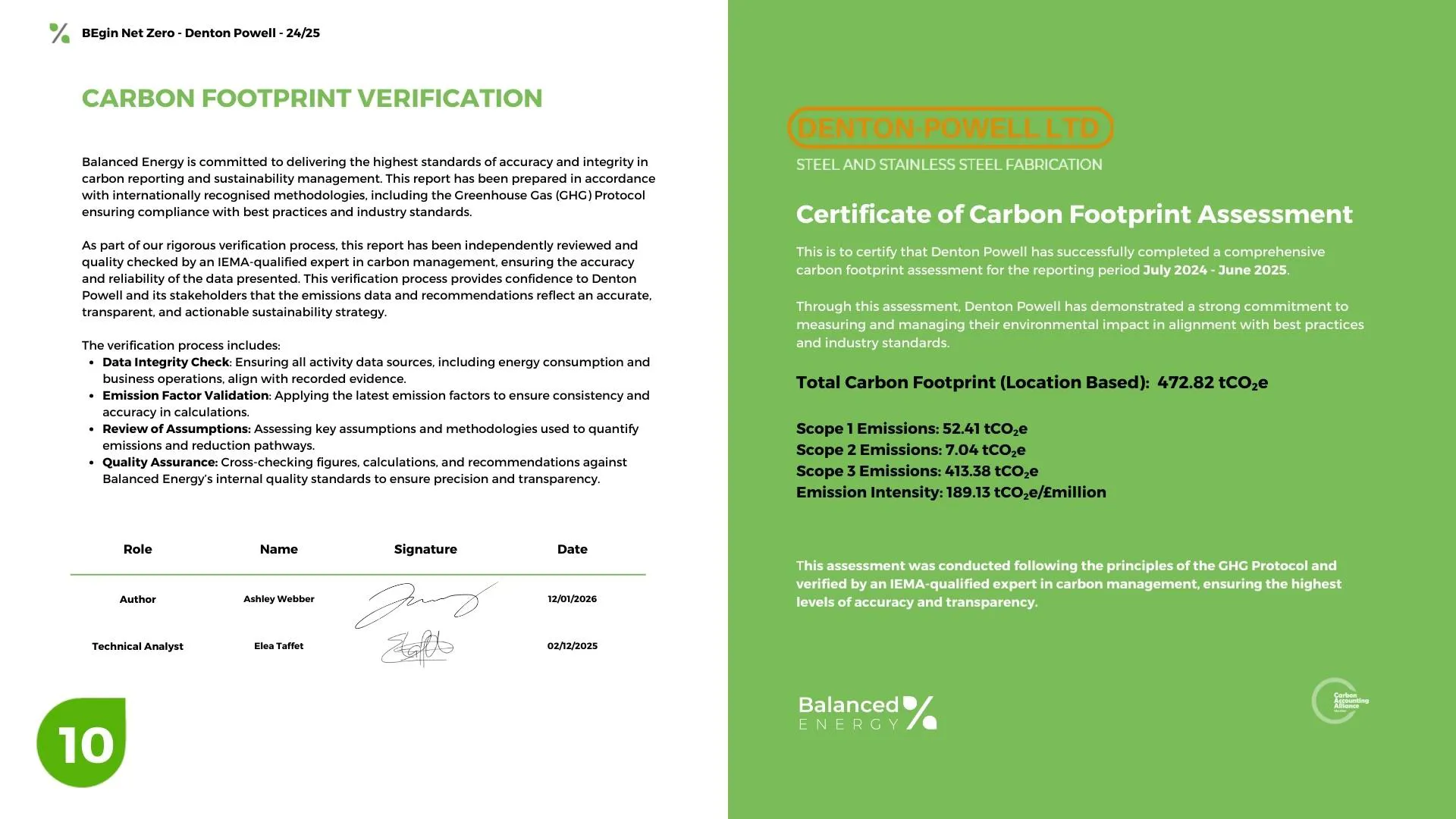
Denton-Powell’s FY24–25 carbon footprint provides a baseline view of emissions across the business and its value chain, calculated in line with the Greenhouse Gas Protocol using an operational control approach.
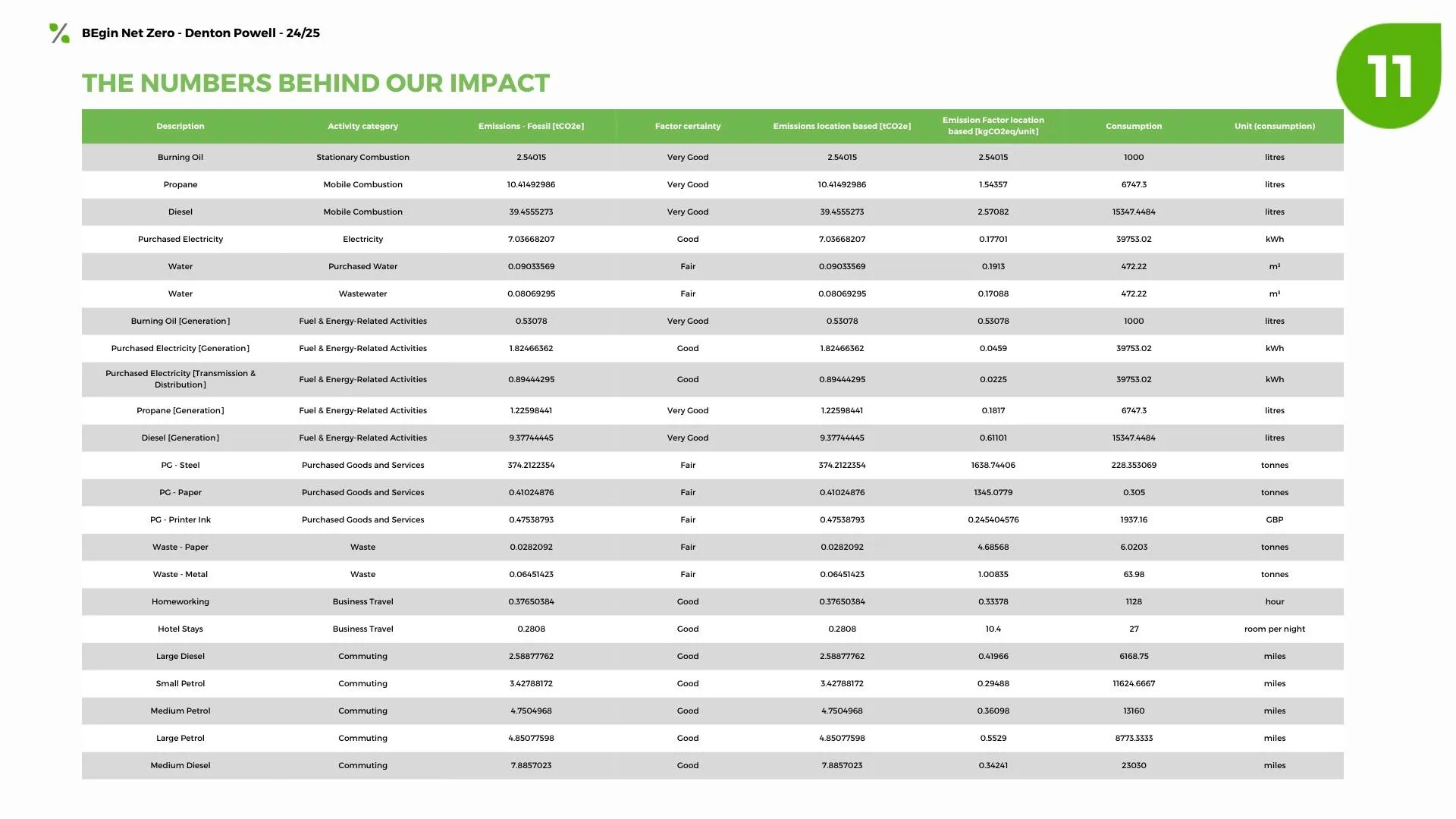
Scope 1 (Direct Emissions): 52.41 tCO₂e These emissions arise primarily from the combustion of fuel in company owned vehicles and plant. They represent the largest share of emissions within Denton-Powell’s direct operational control.
Scope 2 (Purchased Electricity): 7.04 tCO₂e Electricity-related emissions account for a relatively small proportion of the total footprint. While modest in scale, they remain relevant for operational discipline, cost management, and procurement credibility.
Scope 3 (Upstream Value Chain): 413.38 tCO₂e The majority of emissions sit within Scope 3, driven overwhelmingly by Purchased Goods and Services, particularly steel. This reflects the inherent carbon intensity of primary material production rather than inefficiency in Denton-Powell’s operations. This distribution is consistent with the business’s position within the construction supply chain and aligns with wider sector patterns for steel-based trades.
For the 2024–25 reporting period, our total emissions stood at 472.08 tCO₂e (Location-Based).
Our Approach to Carbon Management
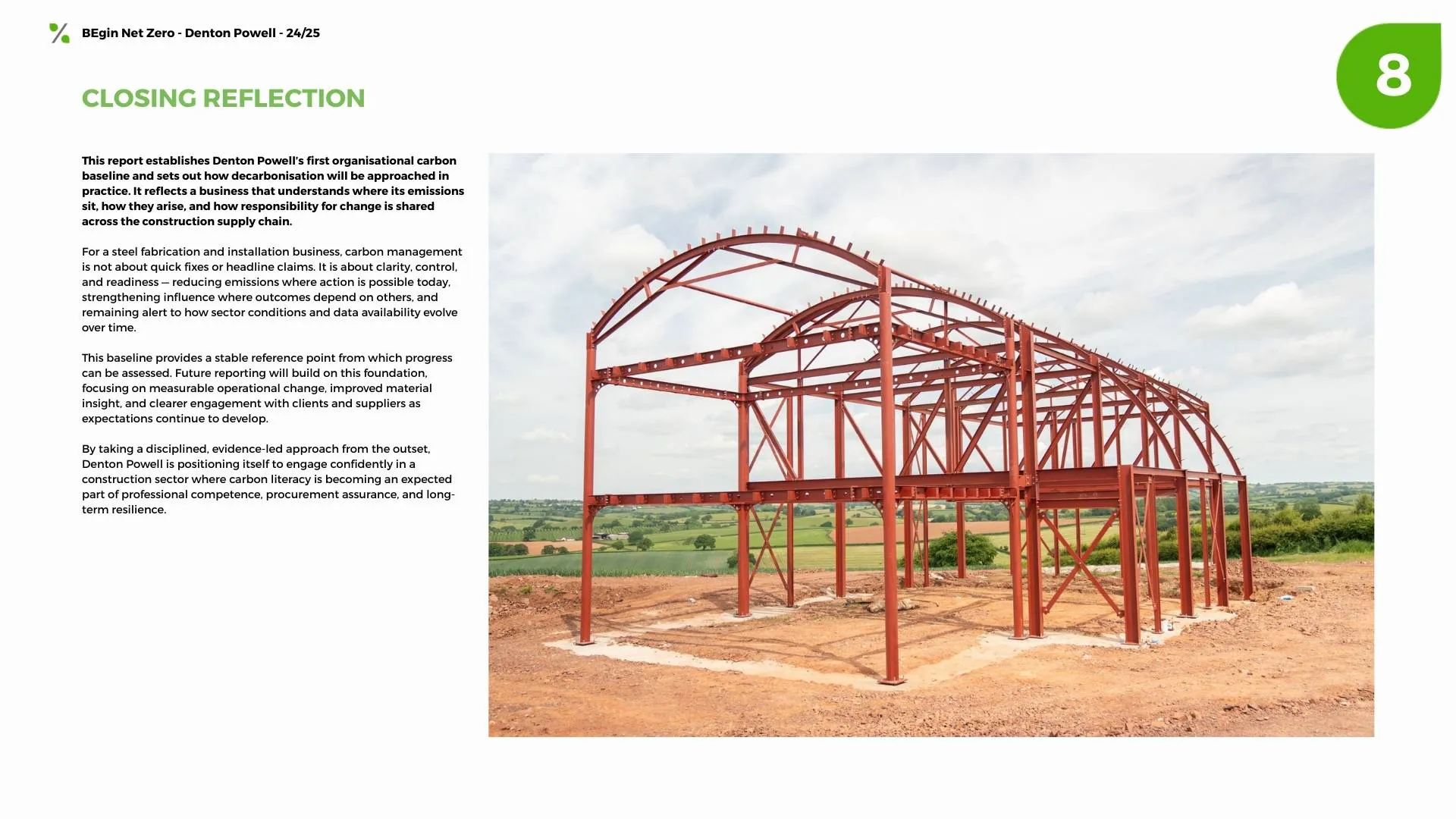
Some elements of our carbon footprint are influenced by wider sector and infrastructure factors, including the pace of decarbonisation in steel production and the availability of lower-carbon materials at scale. Rather than over committing to changes that are not yet deliverable, our approach is to review these constraints regularly, track developments across the supply chain, and remain ready to act as viable alternatives emerge. This means decarbonisation cannot be approached through a single target or short-term fix, but requires disciplined action where emissions are within our direct control, and informed engagement where progress depends on others. For a steel fabrication and installation business, carbon management is about clarity, control, and readiness, reducing emissions where action is possible today, strengthening influence over time, and staying alert to how sector conditions and data continue to evolve. By taking a measured, evidence-led approach from the outset, we are positioning ourselves to engage confidently in a construction sector where carbon literacy is becoming an expected part of professional standards, procurement assurance, and long-term resilience.


SDG Alignment
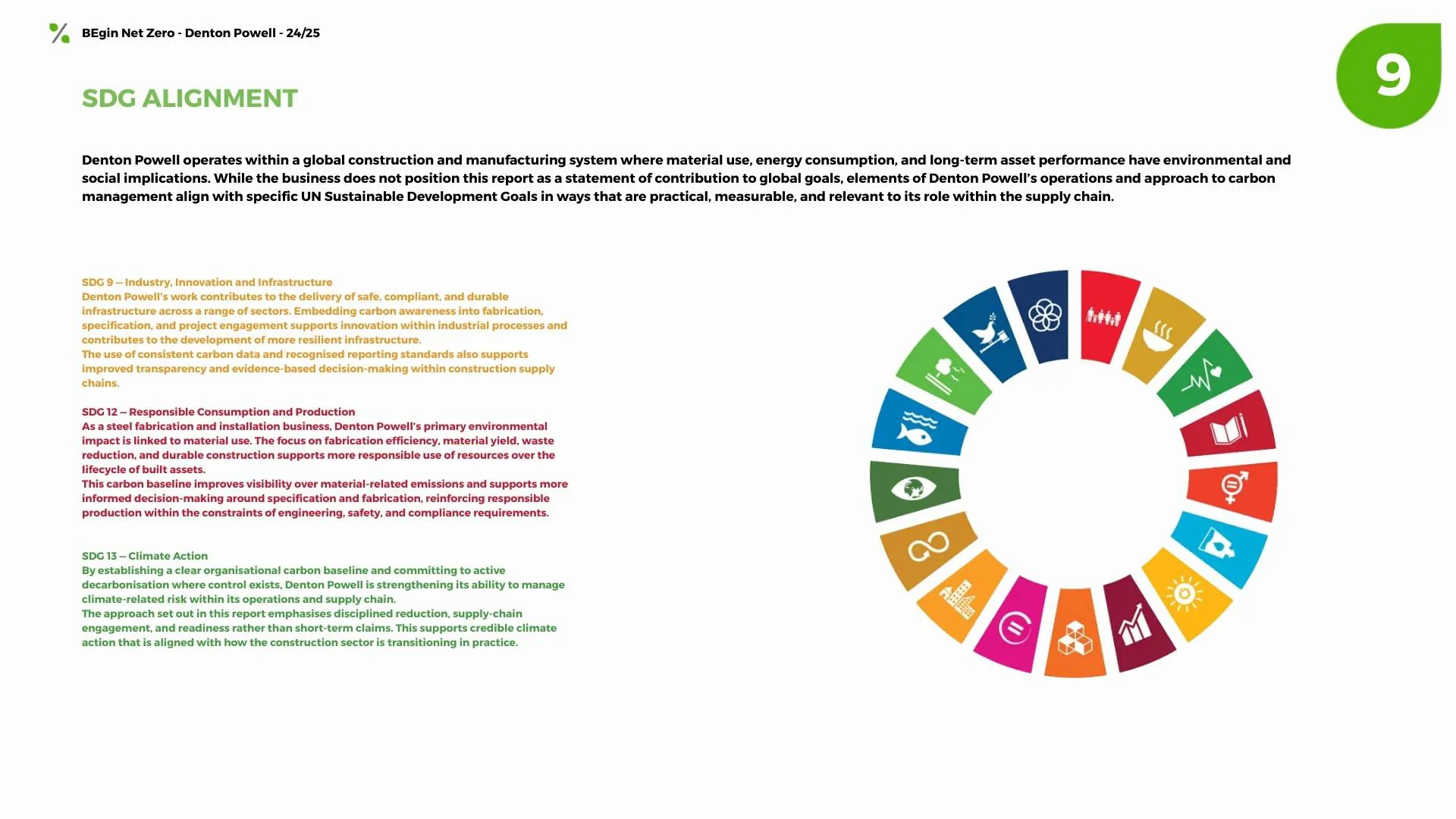
Denton-Powell operates within a global construction and manufacturing system where material use, energy consumption, and long-term asset performance have environmental and social implications. While the business does not position this report as a statement of contribution to global goals, elements of Denton-Powell’s operations and approach to carbon management align with specific UN Sustainable Development Goals in ways that are practical, measurable, and relevant to its role within the supply chain.
SDG 9 — Industry, Innovation and Infrastructure
Denton-Powell’s work contributes to the delivery of safe, compliant, and durable infrastructure across a range of sectors. Embedding carbon awareness into fabrication, specification, and project engagement supports innovation within industrial processes and contributes to the development of more resilient infrastructure. The use of consistent carbon data and recognised reporting standards also supports improved transparency and evidence-based decision making within construction supply chains.
SDG 12 — Responsible Consumption and Production
As a steel fabrication and installation business, Denton-Powell’s primary environmental impact is linked to material use. The focus on fabrication efficiency, material yield, waste reduction, and durable construction supports more responsible use of resources over the lifecycle of built assets. This carbon baseline improves visibility over material-related emissions and supports more informed decision-making around specification and fabrication, reinforcing responsible production within the constraints of engineering, safety, and compliance requirements.
SDG 13 — Climate Action
By establishing a clear organisational carbon baseline and committing to active decarbonisation where control exists, Denton-Powell is strengthening its ability to manage climate-related risk within its operations and supply chain. The approach set out in this report emphasises disciplined reduction, supply-chain engagement, and readiness rather than short-term claims. This supports credible climate action that is aligned with how the construction sector is transitioning in practice.
Looking ahead
Over the months ahead, we will be making small but meaningful changes to help reduce our carbon footprint and build more sustainable ways of working into our day-to-day operations. We are looking forward to seeing how these efforts compare with this year's data, learning from the results, and using them to keep moving in the right direction. By staying proactive and open to improvement, we hope to stay ahead of the curve and lead by example as the shift to a low-carbon future continues.
By establishing a clear carbon baseline and adopting a measured reduction strategy, Denton-Powell is strengthening its position within a construction industry where carbon reporting, sustainability, and responsible material use are becoming essential procurement standards.
.webp)
Denton-Powell approach sustainability in the same way they approach engineering — with honesty, practicality, and a focus on doing things properly.
Their commitment to understanding their carbon footprint and planning for the future shows real leadership for a manufacturing business. It’s not about ticking boxes; it’s about building a stronger, more resilient company for the long term.
Ashley Webber, Director, Balanced Energy
More News & Projects
Check out our News for the latest updates or explore Showcases to read about our bespoke projects in detail.
📧 [email protected]
📞 01460 242114